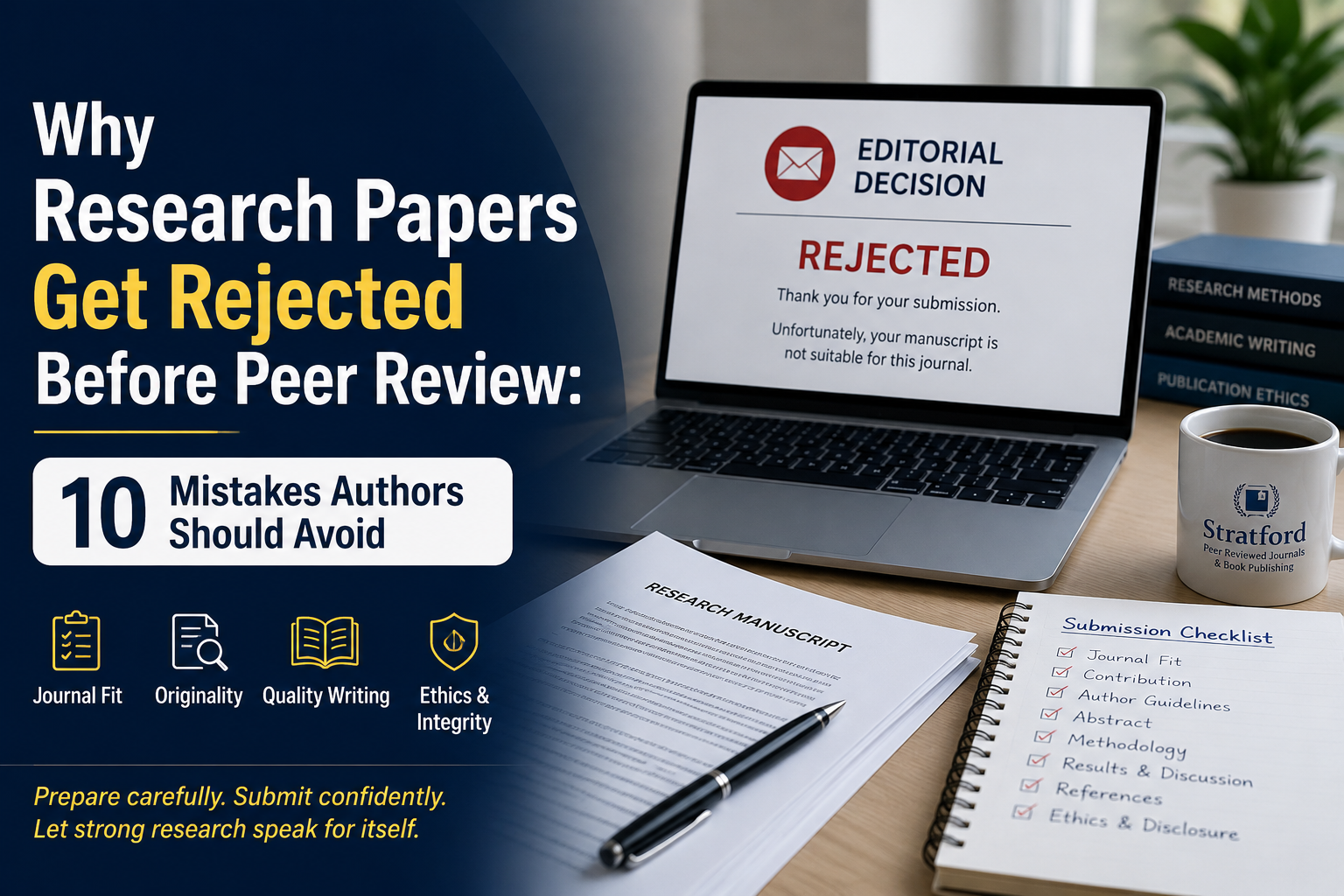
Why Research Papers Get Rejected Before Peer Review: 10 Mistakes Authors Should Avoid
Submitting a research paper to a journal is a significant milestone. After months or even years of collecting data, analysing findings and writing the manuscript, authors naturally expect the next stage to be peer review.
But peer review is not always the first major hurdle.
Before a manuscript is sent to external reviewers, journal editors normally conduct an initial assessment to determine whether it is suitable for the journal and sufficiently prepared for review. Taylor & Francis describes this stage as an editor assessment in which issues such as journal fit, compliance with author instructions, completeness of the submission and contribution to the existing literature may be considered. A manuscript that does not pass this stage may be rejected without external review, commonly known as a desk rejection.
Desk rejection does not necessarily mean that the research has no value. In many cases, the problem lies in how the manuscript was selected, positioned, prepared or presented.
Understanding what editors look for before peer review can therefore help researchers avoid preventable delays and improve the quality of their submissions.
Here are ten common mistakes authors should address before submitting a research paper.
1. Submitting to a Journal That Does Not Match the Research
One of the most preventable causes of rejection is choosing the wrong journal.
A paper may be methodologically strong and contain useful findings but still be unsuitable for a particular publication. Every academic journal has an aims and scope defining the subjects, disciplines, research problems and types of articles it publishes.
Taylor & Francis identifies submission to the wrong journal as one of the common reasons papers are rejected during initial editorial assessment.
Authors should therefore investigate a journal before submitting. Look beyond the journal’s title. Read its aims and scope, examine recently published papers and consider whether researchers who normally read that journal would be interested in your research question.
A useful question is:
“Would this article look at home among the papers this journal already publishes?”
If the answer is uncertain, reconsider the journal choice before submitting.
2. Failing to Demonstrate What Is New About the Research
Editors are not simply asking whether research was conducted correctly. They also want to understand why the research deserves publication.
A manuscript should make its contribution clear. Depending on the discipline, that contribution could involve new empirical evidence, application of a theory in a different context, development of a methodology, examination of an understudied population, resolution of conflicting findings or a new interpretation of an existing problem.
A common weakness occurs when authors provide extensive background information but never clearly state the gap their research addresses.
The introduction should allow an editor to identify three things relatively quickly:
What is already known? What remains unknown? What does this study contribute?
Taylor & Francis notes that lack of a meaningful contribution to existing literature is among the issues editors may identify during initial assessment.
Do not make the editor search through the manuscript to discover why the research matters.
3. Submitting a Thesis Chapter Instead of a Journal Article
A thesis and a journal article are related, but they are not the same publication format.
This is particularly important for postgraduate researchers converting dissertations and theses into journal papers.
A thesis is normally written to demonstrate extensive understanding of a subject and may contain long literature reviews, detailed methodological justification, several research objectives and extensive contextual material. A journal article usually needs a much tighter argument centred on one clearly defined contribution.
Taylor & Francis specifically identifies manuscripts that resemble condensed theses rather than focused journal articles as a possible reason for desk rejection.
When converting a thesis into an article, authors should therefore resist the temptation to simply shorten every chapter.
Instead, identify the strongest publishable argument or finding and reconstruct the manuscript around it.
A strong journal article is not merely a shorter thesis. It is a focused scholarly argument designed for a specific research audience.
4. Ignoring the Journal’s Author Guidelines
Author guidelines are not administrative suggestions. They are part of the submission requirements.
Different journals may specify requirements relating to article length, manuscript structure, abstracts, keywords, tables, figures, referencing styles, declarations and supporting documents.
Wiley notes that manuscripts may fail technical screening when important submission elements are missing. Taylor & Francis similarly identifies failure to follow a journal’s instructions for authors as a common desk-rejection issue.
At Stratford Peer Reviewed Journals & Books, for example, current submission guidance specifies requirements relating to manuscript format, article length, abstract content, major manuscript sections and consistent referencing.
Authors should therefore check the journal guidelines before writing the final version, not five minutes before uploading the manuscript.
Formatting cannot rescue weak research, but poor compliance can create unnecessary obstacles for otherwise publishable work.
5. Writing a Weak Abstract
The abstract is one of the first substantive parts of a manuscript an editor encounters.
It should not function merely as an introduction to the subject. It should provide a concise representation of the complete study.
Depending on the journal and discipline, a useful abstract will normally communicate the research problem or purpose, methodological approach, key findings and main conclusion or implication.
Weak abstracts often spend too much space explaining background information and too little space explaining what was actually done and discovered.
Another common problem is making claims in the abstract that are not adequately supported by the results reported in the main paper.
Before submission, read the abstract independently from the manuscript and ask whether an editor could understand:
Why the research was conducted, how it was conducted, what was found and why the findings matter.
If those elements remain unclear, the abstract requires further work.
6. Using an Inappropriate or Poorly Explained Methodology
An interesting research question cannot compensate for a methodology that does not adequately address it.
Editors and reviewers need to understand how participants, cases, documents, experiments or other units of analysis were selected; how data were collected; how variables or concepts were measured; and how the evidence was analysed.
The level of methodological detail required differs across disciplines and research designs, but the underlying principle remains the same: readers should be able to evaluate whether the methods provide a credible basis for the conclusions.
The problem is not always that the method itself is incorrect. Sometimes the methodology is simply explained too vaguely.
Statements such as “a questionnaire was administered and the data were analysed” are rarely sufficient for an empirical paper.
Authors should make the relationship between the research question, research design, data collection and analysis explicit.
7. Presenting Results That Do Not Support the Conclusions
A research paper should distinguish between what the evidence demonstrates and what the author hopes it means.
One of the questions Stratford asks reviewers to consider is whether results are clearly presented and whether they support the conclusions.
Problems arise when conclusions go beyond the evidence, when statistical results are interpreted inaccurately, when qualitative claims are unsupported by the data presented or when authors introduce entirely new findings in the discussion or conclusion.
Authors should trace every major conclusion backwards through the manuscript.
Can it be connected to a reported finding?
Can that finding be connected to an appropriate analysis?
Can that analysis be connected to the data collected?
If the chain breaks, the conclusion probably needs reconsideration.
8. Poor Academic Writing and Presentation
Editors do not expect every author to write in exactly the same style. They do, however, need manuscripts to communicate research clearly.
Taylor & Francis identifies problems involving grammar, punctuation, academic style, poor presentation and inadequate proofreading among issues that can contribute to rejection.
Poor writing becomes particularly damaging when it prevents an editor from understanding the research question, methodology or findings.
Before submission, authors should examine more than spelling mistakes. Check whether paragraphs develop one coherent idea, whether sections connect logically, whether terminology is consistent and whether unnecessary repetition can be removed.
Tables and figures should also contribute meaningfully to the article rather than duplicate information already explained in the text.
A final manuscript should look like a completed scholarly paper, not a working draft.
9. Weak, Inaccurate or Incomplete Referencing
References show how a paper relates to the scholarly conversation that came before it.
A manuscript may raise concerns when important research is overlooked, citations do not support the statements attributed to them, reference-list entries are incomplete or sources appearing in the text are missing from the reference list.
Authors should also avoid adding references merely to make a bibliography appear longer. Relevance is more important than volume.
Before submitting, verify that:
- important claims are appropriately supported;
- cited literature is relevant to the research problem;
- every in-text citation has a corresponding reference;
- every reference-list entry cited in the paper is accurate; and
- the journal’s required referencing style has been applied consistently.
Accurate referencing strengthens both the credibility and traceability of research.
10. Overlooking Research Ethics, Originality and AI Disclosure Requirements
Ethical concerns can stop a manuscript before conventional peer review begins.
These may include plagiarism, duplicate submission, inappropriate authorship, fabricated or falsified data, undisclosed conflicts of interest, copyright problems or inadequate ethical approval where such approval is required.
Wiley identifies suspected plagiarism and simultaneous submission to another journal among reasons a manuscript may fail technical screening. Taylor & Francis likewise includes plagiarism, duplicate submission, authorship problems, fabrication, falsification and copyright breaches among potential ethical concerns.
The increasing use of generative artificial intelligence has added another issue authors must consider. Journal policies on AI assisted writing and research practices continue to develop, and authors should check the policy of the journal to which they are submitting. Taylor & Francis highlighted AI use, originality, authorship and disclosure as issues being considered during manuscript assessment in its 2026 author guidance and training.
Researchers should therefore never assume that using an AI tool removes their responsibility for the accuracy, originality and integrity of submitted work.
The author remains responsible for the manuscript.
What Should You Check Before Clicking Submit?
A final pre-submission review can prevent many avoidable problems. Before uploading your manuscript, ask yourself:
- Is the research clearly within the journal’s aims and scope?
- Does the paper make a clear scholarly contribution?
- Does the manuscript read like a journal article rather than a thesis chapter or research report?
- Have all author guidelines been followed?
- Does the abstract accurately summarize the complete study?
- Is the methodology sufficiently clear and appropriate?
- Do the results support the conclusions?
- Has the manuscript been carefully edited and proofread?
- Are citations and references complete and accurate?
- Have all originality, authorship, ethics, conflict-of-interest and AI disclosure requirements been addressed?
If you cannot confidently answer yes to each relevant question, another round of revision may be worthwhile.
A Desk Rejection Is Often Preventable
A rejection before peer review can be disappointing, particularly after substantial time has been invested in a research project. But initial editorial screening has an important purpose. It helps journals determine whether manuscripts fit their scope, comply with basic requirements and are sufficiently developed to justify external expert review.
Stratford Peer Reviewed Journals & Books similarly conducts an initial evaluation of submitted manuscripts before the full review process, including initial quality and originality checks. Manuscripts that proceed are evaluated by reviewers on matters including originality, methodological soundness, ethical compliance, presentation of results and engagement with relevant previous research.
For authors, the lesson is straightforward: publication preparation begins before the Submit button is pressed.
Choosing an appropriate journal, demonstrating the contribution of the research, following submission requirements and carefully reviewing the manuscript can substantially improve its readiness for editorial consideration.
Ready to Prepare Your Manuscript for Submission?
Researchers considering publication with Stratford Peer Reviewed Journals & Books can begin by reviewing the Author Guidelines and manuscript requirements to determine the appropriate journal and prepare their paper for consideration.
Once the manuscript has been carefully checked and prepared, authors can use Stratford’s Online Submission facility to submit their work for editorial assessment and peer review. Stratford currently accepts original research papers, case studies, review articles and technical notes subject to its journal requirements and editorial process.
Prepare carefully. Submit confidently. Let strong research speak for itself.